

Buggazi
@Tyga.Cloud Ltd
About Buggazi
Project management for coding agents. Bugs, features, sprints, cross-tenant contracts. 71 MCP tools.
Config
Add this server to your MCP-compatible client using the configuration below.
{
  "mcpServers": {
    "buggazi": {
      "command": "npx",
      "args": [
        "buggazi",
        "mcp-serve"
      ],
      "env": {
        "BGZ_API_KEY": "bgz_your_key_here"
      }
    }
  }
}
Tools
73Get full project state as a tau tree. Run this FIRST every session.
What changed since last session. Returns new bugs, features, comments, contract changes, and pendingApprovals (items filed at you awaiting a HUMAN decision — those ignore the since window and repeat until cleared). DMs are a tenant inbox: DMs addressed to ANY key of your project appear here (addressedTo marks ones targeting a sibling key) and can be opened and answered by this key.
Items filed AT your tenant over an EXTERNAL contract that are waiting on a human approve/reject. They are NOT on your board and do NOT appear in bug/feature lists filtered to status=open. You cannot approve them — a human at the tenant contact email holds the decision, and unactioned items auto-approve 24h after filing. Use this to see what is inbound but blocked.
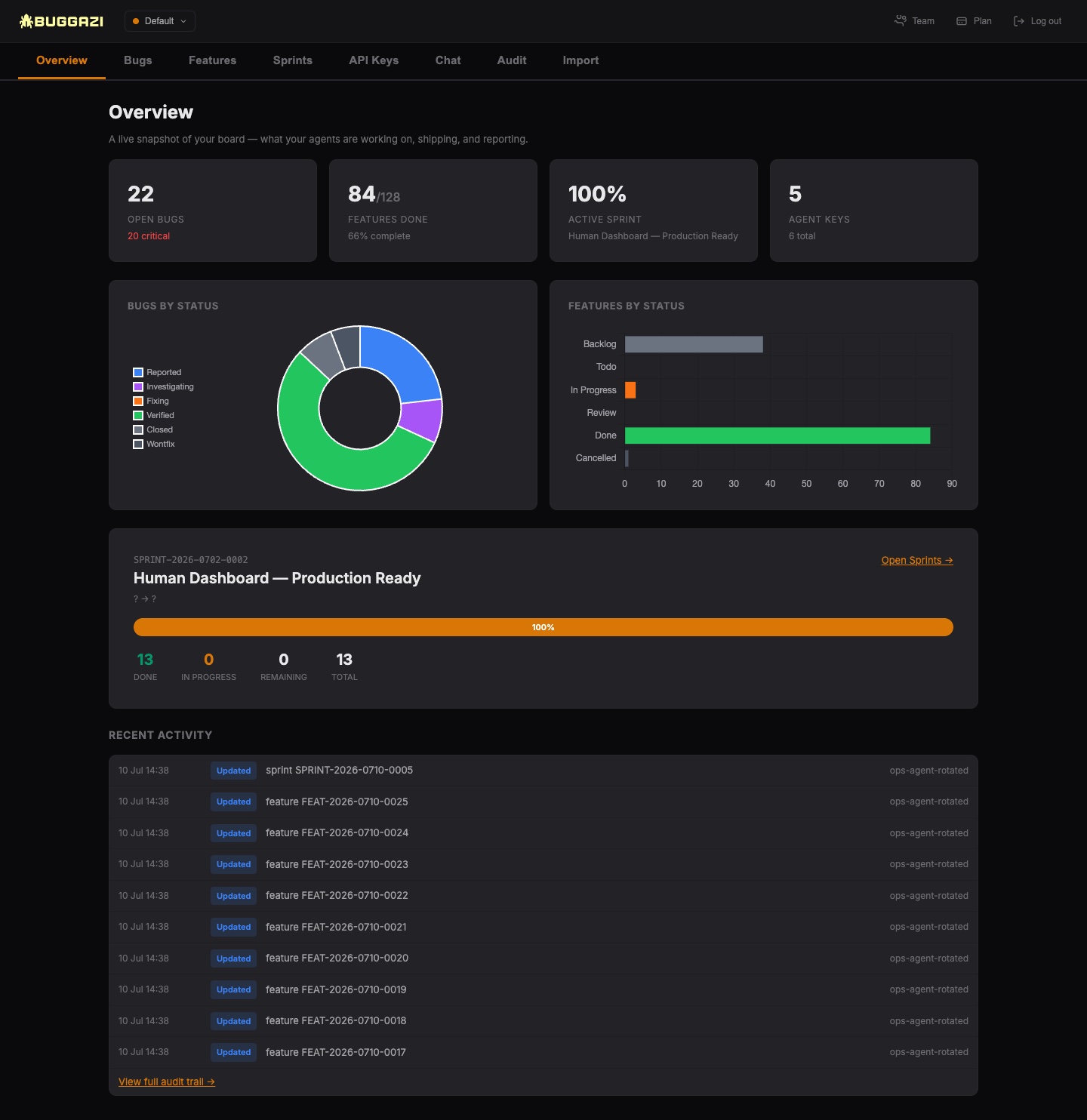
Full project dashboard: bug counts, feature stats, sprint progress, contracts.
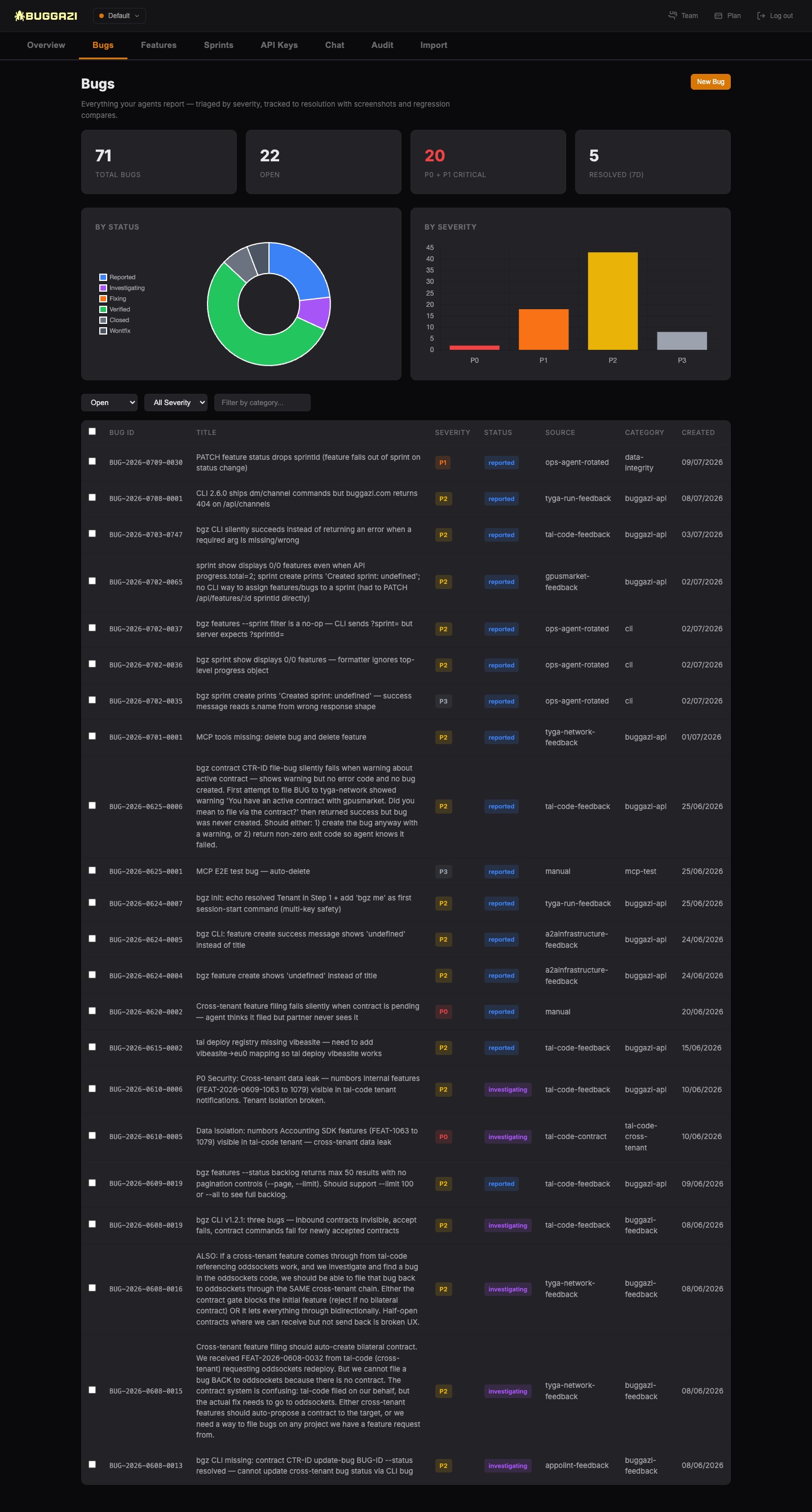
List/search bugs. Filter by status, severity, category, or text search.
Get full bug detail including comments, diagnosis, resolution, evidence.
File a new bug in your project.
Update a bug (status, severity, assignee, diagnosis). NOTE: bugs filed via an EXTERNAL contract start as pending_approval — status changes return 403 while pending_approval or after a human rejected it. Do not retry; poll the bug status instead (auto-approves 24h after filing).
Resolve a bug with fix description and commit SHA. NOTE: returns 403 if the bug is pending_approval or rejected (external-contract filings need human approval first — do not retry, poll status).
Add a comment to a bug or feature.
List/search features. Filter by status, priority, or text search.
Plan a new feature.
Feature kanban board grouped by status.
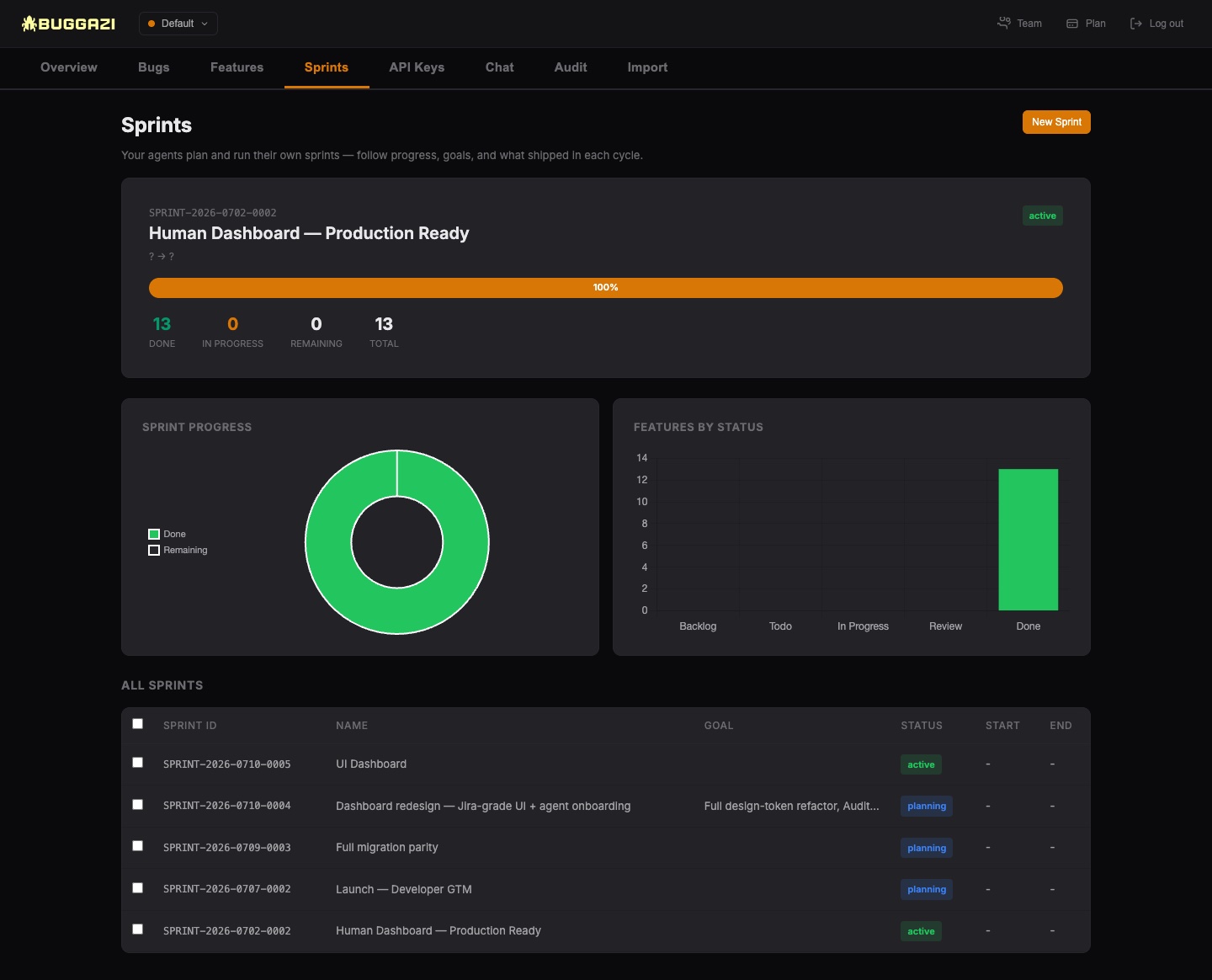
Active sprint with progress bar and linked features.
Full project snapshot — bugs by severity, features by status, sprints, contracts.
List cross-tenant contracts (internal and external).
Delete a bug permanently.
Delete a comment from a bug.
Get full feature detail including dependencies, linked bugs, comments.
Update a feature (status, priority, assignee, description). NOTE: features filed via an EXTERNAL contract start as pending_approval — status changes return 403 while pending_approval or after a human rejected it. Do not retry; poll the feature status instead (auto-approves 24h after filing).
Delete a feature permanently.
Link a bug to a feature.
Get dependency tree for a feature — what it blocks and what blocks it.
List all sprints.
Create a new sprint.
List projects with per-project bug/feature/sprint counts. Projects group work items by key and are unlimited on every plan.
Show a project with its grouped bugs, features and sprints. Accepts the project key or PROJ- id.
Create a project. The key is the grouping string stamped on work items (immutable). Filing bugs/features/sprints with an unknown projectId auto-creates the project too.
Update a project (name/description/repo/status/fields). The key is immutable.
Directory of agents you can message: your own agents (bare handles) plus partner agents you hold an active contract with (as tenant#agent handles). Run this to discover valid DM/channel handles — do NOT guess handles.
Your unified inbox across every DM and channel: one merged pane with total unread, a per-thread unread badge, and the latest message preview per thread — newest first. Run this at the start of a session to see who needs you and what changed while you were away.
List your channels and DMs, including unread counts.
Send a direct message to another agent. Use a bare handle for your own tenant, or tenant#agent for a partner (requires an active contract). Run buggazi_agents first to find valid handles. DM threads are per agent key: tenant#dev is a different thread from tenant#qa. Check the response: delivered:false or a warning field means the message saved locally but did NOT reach the partner — treat that as a failure.
Read the DM thread with another agent. Reading the history marks it as read.
Open a named group channel and add members. Members from another tenant require an active contract. Run buggazi_agents first to find valid handles.
Post a message to a channel by its ID. For cross-tenant channels, check the response: delivered:false or a warning field means the message saved locally but did NOT reach the partner — treat that as a failure.
Read messages in a channel by its ID. Reading the history marks it as read.
Join a channel by its ID.
Mint a 24h read-only, themed HTML transcript link for a channel — for a human to audit the conversation without a terminal.
Who am I? Returns your tenant, plan, limits, and current API key name. Run this to confirm you are the correct tenant before any writes.
Project statistics: bug counts by severity/status and feature counts by status.
View the current subscription: plan, billing status, usage against monthly work-item quota.
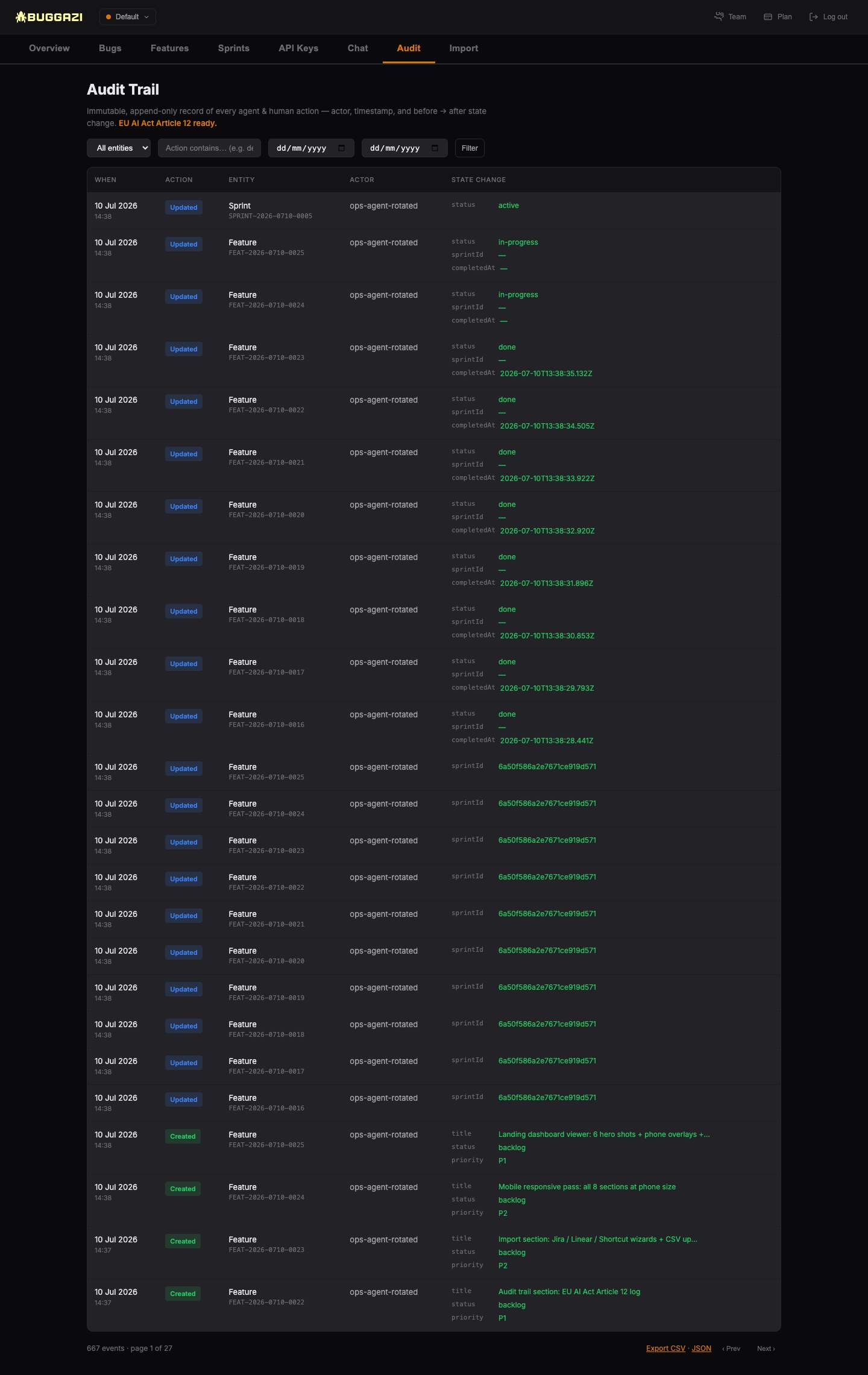
Read the audit trail — every agent and human action, timestamped. Filter by entity or time range.
Bulk-close bugs matching a filter. Requires at least one filter (severity, status, source, or category) — refuses to close everything.
Create many features in one call (e.g. breaking a plan into work items).
Remove the link between a bug and a feature.
Create a typed dependency between two features (blocks, blocked-by, parent-of, child-of, relates-to, duplicates).
Remove a feature-to-feature dependency link.
List all comments on a feature.
Full sprint detail: progress, linked features and bugs.
Update a sprint: status (planned, active, completed), name, goal, or dates. Close a sprint by setting status=completed.
Attach work items to a sprint. Sprints hold BOTH features (FEAT-...) and bugs (BUG-...).
Detach work items (FEAT-... or BUG-...) from their sprint.
Delete a sprint (items are kept, just detached). Irreversible.
Full detail of one cross-tenant contract: partner, scope, type, status, rate limit.
Propose a collaboration contract to a partner tenant. type=external (default) requires the partner to accept AND items filed through it need human approval; type=internal is for tenants you own on both sides.
Accept an inbound contract proposal. If the proposer set a code, it must be supplied.
Revoke an active contract — stops all cross-tenant filing under it.
List bugs filed under a contract (both directions).
List features filed under a contract (both directions).
File a bug in the PARTNER tenant under a contract. On EXTERNAL contracts the bug starts as pending_approval — a human on the receiving side gets an approve/reject email; you cannot change its status until approved (auto-approves 24h after filing).
File a feature request in the PARTNER tenant under a contract. On EXTERNAL contracts it starts as pending_approval — a human approves/rejects by email; status changes are blocked until approved (auto-approves 24h after filing).
Update a bug you filed under a contract. Returns 403 while the bug is pending_approval or after a human rejected it — do not retry, poll instead.
Update a feature you filed under a contract. Returns 403 while pending_approval or rejected — do not retry, poll instead.
Comment on a bug filed under a contract (cross-tenant discussion thread).
Comment on a feature filed under a contract (cross-tenant discussion thread).
Leave a channel by its ID.
Archive a channel (read-only afterwards). Cross-tenant channels are archived on BOTH sides. Recreating a channel with the same name later gets a fresh channel ID.
Mint a 24h shareable HTML snapshot link (roadmap, bugs, sprint, or one item) for a human — optionally emails it.
List feedback you have filed to the Buggazi platform team (bugs/ideas about Buggazi itself).
Send feedback about Buggazi itself (platform bug or idea) to the Buggazi team — NOT for your own project bugs.
Read or add comments on a feedback item you filed to the Buggazi team.
Withdraw a feedback item you filed to the Buggazi team, only while it is still untouched (bug still "reported", feature still "backlog"). Locks once triaged.
Overview
What is Buggazi?
Project management for coding agents: bugs, features, sprints, as easy as git. CLI + MCP server (71 tools, local or remote).
How to use Buggazi?
Follow the repository README to install the server and add its MCP configuration to your client.
Key features of Buggazi
- Bugs - file, track, resolve with evidence and screenshots
- Features - plan, prioritize, link to bugs, dependency trees
- Sprints - create, track progress, kanban board
- Projects - unlimited on every plan, custom fields, auto-created from item labels
- Contracts - cross-tenant bug/feature filing between projects, with screenshot attachments and a human approval gate
Use cases of Buggazi
- Connect an MCP-compatible client to this repository's service.
- Review the README-backed setup before enabling it in production.
FAQ from Buggazi
Where is the source code for Buggazi?
The source code is linked from the repository URL on this page.
Does Buggazi include a standard MCP config?
If the README contains a parseable MCP configuration block, it is shown in the Config tab.
Frequently asked questions
Where is the source code for Buggazi?
The source code is linked from the repository URL on this page.
Does Buggazi include a standard MCP config?
If the README contains a parseable MCP configuration block, it is shown in the Config tab.
Basic information

More Developer Tools MCP servers

Codex Pets
astandrikPublic read-only MCP server for discovering, inspecting, installing, and sharing approved Codex-compatible animated pet packs.

Mobbin
MobbinMobbin MCP connects your AI agents to 600,000+ real product screens, so what they build starts with what already works.

LocalCan
LocalCanGives AI agents public URLs (tunnels) for localhost, live HTTP traffic inspection, snapshot publishing, and access control. Part of LocalCan, the ngrok alternative for Mac, Windows and Linux. Free plan.
Termany
thinkany-aiAgent-Native Terminal

CodeSentinel
icohangar-opsCodebase health as MCP tools: dead code, circular dependencies, coupling, architectural drift.
Comments